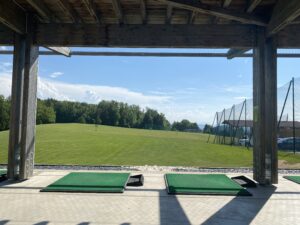
Golf Fitting, why and how to choose the right clubs
The golf fitting This is undoubtedly the most cost-effective investment for lasting improvement, without spending months trying to "fix" your swing. In just one session, your clubs are adjusted to your speed, trajectory, and natural tendencies—slice, hook, low shots, excessive dispersion. When the equipment stops working against you, you stop compensating.
At Golf du Belvédère, this session is conducted by Adrien, our fitting specialist at the Proshop. His approach is based on a simple principle: a club isn't validated on a mat, it's validated on the course. That's why every fitting concludes with actual shots on our 9-hole course, on the same day — a step few clubs offer, and one that makes all the difference in the reliability of the diagnosis.
Expert advice: Book your fitting with Adrien directly at the Proshop, on our 250-meter practice area spread over several levels, before validating your settings on the course the same day.
Table of Contents - Getting a golf fitting: why and how to choose your clubs
In 2 minutes: the summary
A fitting is designed to reduce dispersion, stabilize height and trajectory, and recover useful distance—the kind that comes around regularly, not the perfect Sunday shot. You test several combinations (heads, shafts, loft, lie, grips), you measure objectively, and then you leave with clear specifications: what to change, in what order, and why.
Book your session directly with Adrien at our Proshop, on our 250-meter practice area spread over several levels — one of the largest in Haute-Savoie — to test in real conditions before moving on to the course.
«"Is fitting a scam?" Myth vs. reality
The word "scam" comes up often because some fittings resemble disguised demonstrations, with a conclusion already written in advance. A good fitting, on the other hand, is like a mini-laboratory: data, comparisons, and a recommendation that is justified.
A proper fitting is:
- Objective measurements and a basis for comparison
- Several options were tested (at least two or three shafts, two heads or settings)
- Clear explanations, without catalogue jargon
- A pre-sale assessment: we discuss adjustments before discussing the purchase
- Validation on the course, not just in the cage
A fake fitting is:
- One single "miracle" club tried three times
- Zero data, only "by feel".«
- A pressure to buy immediately
- A session where your swing is "corrected" with every ball
Expert advice: At Adrien's, no sale is offered until the diagnosis has been made and validated with you. You leave with written specifications, whether you decide to buy from us or not.
Who does it really benefit (and who doesn't benefit from it right now)?
You should get a fitting if:
- Your good moves exist, but they don't happen often enough.
- You have a troublesome lateral dispersion, to the right, to the left, or randomly.
- You often change your equipment without ever being sure of your choice.
- You want to buy a driver or a series without throwing money away
You can wait a little while if:
- You are a beginner and are not yet repeating stable trajectories.
- You are in the midst of a major technical overhaul
In this case, a mini safety fitting — grip, length, lie — may be sufficient before considering a full fitting.
| Fitting type | What is adjusted | For whom |
|---|---|---|
| Safety fitting | Grip, length, lie | Beginners, swing still unstable |
| Targeted fitting | Only one club (driver, irons or putter) | Players with an identified problem at a specific club |
| Complete fitting | Complete bag: woods, irons, wedges, putter | Regular gamers looking to optimize all their equipment |
What fitting actually improves
Dispersion, your true adversary
On a golf course, what costs the most is unpredictability: rough, trees, hazards, and changes in direction. Club fitting aims primarily to tighten your playing area, not to gain a few isolated yards.
The useful distance, not the legendary one
You can gain meters, that's true. But the real gain is a repeatable distance. Fitting puts reality back at the center: you build your strategy on shots that come back around, not on a one-off feat.
The trajectory and the height
Balls too low, too high, inconsistent spin? With the right loft, shaft, head and weight settings, you get a trajectory that stays on the fairway and attacks the greens better.
What is measured during a fitting session
A proper fitting is based on numbers, not impressions. Adrien uses a launch monitor to capture, with each shot, a set of data that objectively tells what happens between the club and the ball.
- Clubhead speed and ball speed : the basis for calculating your real distance potential
- Smash factor : the ratio between the two speeds, which indicates the quality of the contact
- Launch angle and spin rate This determines the height, range, and stability of the ball once it has landed.
- Carry and total distance : the actual distance in flight, then with the roll
- Lateral dispersion : the difference between your strokes, left/right, over a series of strokes
This data is then compared from one club to another, from one shaft to another, to objectively determine what is truly at play. It is this rigor that distinguishes a fitting from simply trying out clubs off the shelf.
What happens during a golf fitting session at Golf du Belvédère?
Our process is simple and always ends with a confrontation with the reality of the journey:
- Define the objective with Adrien — straighter, higher, more carry, less slice
- Measure your current club on our 250-meter driving range to establish a benchmark
- Test several combinations by changing one variable at a time
- Validate the best option over several shots, not two heroic shots.
- Confirm your choice directly on our 9-hole course, under real playing conditions.
- Leave with written specifications and a priority order
This final step on the course is what distinguishes a reliable fitting from a "showcase" fitting: a club can look perfect on the mat and behave differently in real play, with elevation changes, wind, and the pressure of a real hole to play.
Fitting driver, irons, wedges, putter: what changes depending on the club
Not all club categories fit in the same way, because the stakes are different from one club to another. Here's what Adrien adjusts first, depending on the club in question.
Driver
The driver is the club where the difference between a bad and a good setup is most noticeable: loft, head position, stiffness, and shaft profile directly influence dispersion and distance. A shaft that is too stiff for your swing speed limits distance; a shaft that is too flexible degrades trajectory control.
Irons
With irons, priority is given to lie angle and length: an incorrect lie angle will consistently send the ball left or right, even with a technically sound swing. The gapping between each iron—the consistent distance difference from one club to the next—is also checked to avoid gaps or overlaps in your bag.
Wedges
For wedges, the focus is on control rather than distance: bounce, loft and sole width are adjusted according to your swing type and the ground conditions you most often encounter on the course.
Putter
Putter fitting focuses on length, lie angle, head balance, and visual alignment. These are often the easiest adjustments to make, resulting in an immediate improvement in the number of putts per round.
Duration, budget and order of priority
How long ?
Allow generally 45 to 90 minutes depending on the number of clubs and options tested, including validation on the course.
How much does it cost?
The price depends on the level of service desired: a fitting focused on a single club, or a complete fitting with several sets. Adrien will provide you with a personalized quote at [phone number/email address]. Proshop tailored to your needs — with no obligation to buy after the session. Remember this: a fitting is almost always cheaper than a bad purchase. Buying a club based on gut feeling that only exacerbates your weakness is a real waste.
Where to begin?
- Driver if you're losing shots or if the dispersion is huge — fitting driver
- Irons if you want more consistency and better contact with the greens — fitting irons
- Wedges if you're looking for distance control and ball stopping power
- Putter if you want to reduce three-putts — fitting putter
Two concrete examples
«"I slice, so I aim left... so I slice again."»
Profile: Amateur golfer, teeing off to the right and hitting a slice. Fitting approach: more forgiving clubhead, loft/face adjustment, shaft better suited to the tempo, validation on the driving range and then on the tees of the course. Objective: a more stable tee shot and tighter dispersion, to stop "slicing.".
«"I never know how far away I am."»
Profile: Regular player but inconsistent iron distances. Fitting approach: Consistent lie and length, shaft that stabilizes height, cleaner gapping, confirmed on several greens of the course. Objective: More consistent trajectories and greater confidence on approach shots.
«"I'm losing all my putting distance."»
Profile: A player with a good long game but a putting style that proves costly at the end of the round. Fitting approach: Adjusting the putter's length and lie, reviewing visual alignment, and validating the fit on the putting green and then on the course greens. Objective: To reduce the number of three-putts and regain confidence over mid-range distances.
Anti-disappointment checklist: 7 questions to ask before booking
- Are the following data being measured: carry, dispersion, spin, launch?
- Are we testing multiple shafts and settings, or just one option?
- Do we change one variable at a time?
- Are we leaving with written specifications?
- Can the fitting be targeted, driver only or putter only?
- Is the goal performance, or clearing the current stock?
- Is it validated over several sets of balls, and ideally over the course?
At Adrien's, the answer is yes to all seven questions — that's our standard, not an option.
How often should a fitting be done?
A club that's perfectly suited to you today won't stay that way forever. Your swing evolves with regular practice, technical improvements, or simply the passage of time. A check-up every two to three years ensures your club specifications are still consistent with your current game. Certain signs should also alert you earlier: a sudden drop in consistency, a feeling of unexplained distance loss, or a significant change in your swing technique. In these cases, a quick consultation with Adrien is often enough to determine whether the equipment or your swing is the issue.
What you should do now
If you're planning to buy equipment before the season starts, do the opposite of most golfers: first get fitted, then check the specifications, and finally buy. Poorly fitted equipment will hold you back all season, whereas a 45- to 90-minute fitting session is all it takes to fix it.
For a simple and effective approach, start with a targeted fitting—driver, irons, or putter—with Adrien, validated on our 250-meter driving range and then confirmed on the 9-hole course at Golf du Belvédère in Saint-Martin-Bellevue. You'll immediately see if your approach is sound, and your game will thank you.
Conclusion: the step that transforms a random purchase into a measurable investment
Golf club fitting isn't a marketing gimmick: it's the step that transforms a random purchase into a measurable investment. By aligning your clubs with your actual swing—and not the other way around—you gain consistency, useful distance, and confidence on every approach to the green. golf It remains a technically demanding sport where the slightest adjustment counts, and an unsuitable club can hinder your progress for entire seasons.
At Golf du Belvédère, this requirement takes a concrete form: a diagnostic assessment conducted by Adrien, tests on our 250-meter driving range, and a final validation on our 9-hole course, under real-world conditions. It is this last step, rarely offered elsewhere, that makes the difference between a club that seems good and a club that truly delivers on the course. Book your fitting with Adrien.
FAQ: Getting a golf fitting, why and how to choose the right clubs
What is a golf fitting?
A golf fitting is an analysis session where your clubs—shaft, loft, lie, length, grip, and head—are tested and adjusted to match your current swing. The goal isn't to correct your technique, but to adapt the equipment to your natural movement for more consistent shots.
Do you need a good skill level or a stable swing to get a fitting?
No, there is no minimum handicap requirement. A beginner benefits from a basic fitting—grip, length, lie—to avoid playing with equipment that amplifies their weaknesses. An experienced player, on the other hand, refines their dispersion and effective distance with a complete fitting.
Indoor or outdoor fitting: what's the difference, and which one to choose?
Indoor fitting, using a simulator, measures swing data indoors, sheltered from the wind and real-world conditions. Outdoor fitting, on a course or driving range, compares these same settings to the reality of the game—elevation changes, ground distances, and the pressure of a real hole. At Golf du Belvédère, each session combines both: testing on our 250-meter driving range, followed by final validation on the 9-hole course.
Does the fitting really lower the score?
Yes, especially by reducing penalty shots: fewer stray balls, fewer recovery shots, more playable tee shots, and more greens hit. Fitting doesn't correct the swing; it makes good shots easier to reproduce.
Driver or irons: which club should be fitted first?
Start with what costs you the most strokes on the course. The driver, if you're losing balls or if your shots are inconsistent. The irons, if your distances vary too much and you lack consistency on your approach shots. A fitting focused on just one club will already provide an immediate benefit.
How long does a fitting take and how much does it cost?
A fitting typically lasts 45 to 90 minutes, depending on the number of clubs tested. The price depends on the level of service—targeted or comprehensive fitting—and a quote is provided on a case-by-case basis. A simple rule of thumb: a fitting almost always costs less than a bad purchase made on a whim.
Should you have your club fitting done regularly, even with the same clubs?
Yes, a swing evolves with practice, physical condition, and time. A club that was perfectly suited to you three years ago may no longer be so today. A check-up every two to three years, or as soon as consistency declines, allows you to verify that your equipment is still working for you.