Golf swing for beginners: the complete method for an effective swing from your very first shots
The golf swing for beginners It rests on three simple pillars: clean contact with the ball, controlled direction and a regular rhythm.
Contrary to a widespread misconception, the goal is not to achieve a perfect or spectacular swing, but a stable, reproducible and balanced movement.
By prioritizing posture, grip, and tempo over power, you will progress faster than most beginners — and you will quickly gain consistency and confidence on the course.
Expert advice: Before seeking power, focus on contact: this is the basis of any truly effective beginner golf swing.
Table of Contents - Golf Swing for Beginners: The Complete Method for an Effective Swing from Your First Shots
The top priority: contact before power
Many beginners want to hit the ball far from their very first practice sessions. The result is almost always the same: muscle tension, imbalance, topped shots, and uncontrollable slices. Your priority during the first few months of practice should remain simple: hit the ball cleanly, in the center of the clubface, with a controlled swing.
A swing executed at 70° of maximum power, but with good contact, will often go further and straighter than a forced swing at 100°. This rule is particularly important for a golf swing for beginners : it determines your progress curve over the first six months.
Why a beginner's golf swing is different from an experienced player's swing
An experienced player seeks to optimize their clubhead speed and refine their trajectory. A beginner, on the other hand, must first build reliable motor reference points: where the ball is in relation to the body, what amplitude to give to the movement, how to link the backswing and downswing without consciously thinking about it.
That is why a golf swing for beginners It should never be compared to that of an experienced player. The goals, priorities, and even the pace of learning are different. Trying to imitate a professional's swing too early is, in fact, one of the most frequent causes of technical difficulties among new golfers.
Step 1: Posture
A solid swing is built even before you move the club. Posture stabilizes the body, facilitates contact, and limits compensations which, in the long run, become bad habits that are difficult to correct.
Foot position
- Shoulder width (slightly wider with a driver)
- Toes slightly turned out
- Weight distributed in the center of the feet, neither on the heels nor on the toes
Flexion and back
- Slight bend in the knees
- The tilt comes from the hips, never from the back, which must remain straight.
- Neutral back, eyes fixed on the ball
Hand position
- Hands slightly in front of the ball with the irons
- Arms relaxed, no tension in the shoulders
Step 2: The grip
A neutral grip allows the clubface to return to a straight position at impact. This is one of the most crucial adjustments for ball trajectory — and yet one of the most overlooked by beginner golfers.
A simple reference point for a right-handed player:
- Left hand: you should see 2 to 3 phalanges
- Right hand: palm facing the target
- Moderate pressure, neither tight nor loose
A grip that's too tight tends to close the clubface at impact, while a grip that's too loose tends to open it. To get started, avoid changing your grip every week: let it settle in over several sessions before judging its effectiveness.
Step 3: The backswing
The goal of the backswing is to rotate the club, never to raise the arms abruptly. A backswing that is too fast invariably results in a disorganized downswing and inconsistent contact.
What you should feel:
- Shoulder rotation
- Hips slightly engaged in the movement
- Arms that rise in connection with the body, not independently
What to avoid:
- Raising only the arms without rotating the torso
- Lean towards the ball during the ascent
- Straighten up while moving
Step 4: The Transition
The transition is the pivotal moment between the upswing and downswing of the club. This is where most beginners make their most costly mistake: accelerating abruptly with their arms instead of letting their lower body initiate the movement.
What to look for:
- Let the descent begin with the hips and legs
- Maintain a steady, smooth rhythm
- Keep your head steady throughout the transition
Think rotation, not striking: this nuance radically changes the quality of the contact.
Step 5: The Impact
A good impact with an iron produces ball contact before the ground, followed by a divot after the ball, with a distinct compression feel. If you're hitting the ground before the ball, posture or weight transfer is almost always the issue.
- Contact ball before ground
- Divot after the ball, never before
- Sensation of compression upon contact
Stage 6: The Finish
The finish reveals the overall quality of the swing. A good finish should be stable and perfectly balanced, without needing to correct your position.
- Weight transferred to the front leg
- Body facing the target
- Club positioned behind the head
- Stable balance, maintained naturally
If you lose your balance at the finish, it's a sign that the swing was out of sync somewhere beforehand.
The swing made easy (5-step method)
Here is the condensed version of a golf swing for beginners, to be memorized before each move:
- Stable installation
- Slow and controlled ascent
- A brief pause at the top of the swing
- Smooth descent initiated from the lower body
- Balanced finish
Mentally rehearse this sequence before each shot, including on the course. It's an excellent pre-shot routine reflex.
Typical mistakes and quick fixes
| Issue | Common cause | Simple correction |
|---|---|---|
| Slice (ball starting to the right) | Open front + outdoor club path | Slightly reinforced grip + more inward swing |
| Top (ball skimming the ground) | The body straightens upon impact | Maintain posture + look down |
| Scratch (the ground is touched before the ball) | Weight remained too far back | Weight transfer to the front leg |
| Lack of distance | Deceleration during the downswing | Maintain a consistent pace from beginning to end |
Key exercise: the half-range swing
To progress faster, practice swings with a 50-degree amplitude: this improves your centering, coordination, and confidence, without the tension associated with chasing distance. Ideally, use a 7-iron and focus on consistency rather than length.
- Swings with a 50 % amplitude
- Exclusive focus on contact
- 7 iron for its versatility
- Consistency before distance
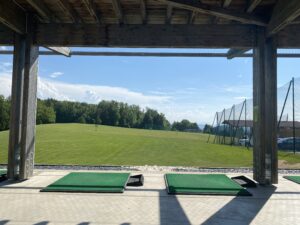
Expert advice: The covered and multi-level practice area at Golf du Belvédère (230 meters) is particularly well suited to this type of repetitive exercise: you can train there all year round, including when the weather discourages other golfers.
Driver: when to incorporate it into your swing?
Incorporate the driver into your practice when you consistently make clean contact with your irons, maintain balance at the finish, and your ball dispersion decreases significantly.
- Tee planted lower than one would generally think
- Swing executed at 80 % of power
- Direction is the primary focus, distance is never the priority.
A simple 4-week training plan to master your beginner golf swing
Week 1
- Focus exclusively on posture and grip
- 70 % of time at iron 7
- 30 % of putting time
Week 2
- Repeated half-swings
- Specific work on ball-ground contact
Week 3
- Full, controlled swings
- Gradual introduction of the hybrid
Week 4
- Simulation of a course with different targets
- Trajectory management in real-world conditions
Taking a course to accelerate your progress
Reading the game alone is never a substitute for an outside eye. A swing that looks correct on paper may be hiding a flaw invisible to you, but obvious to a professional. The Belvédère Annecy Golf Course, Julien accompanies beginners during private lessons and introductory courses, with a simple objective: to correct the basics before they become habits.
To progress faster and structure your learning, also check out our related articles:
Golf swing for beginners: the essentials to remember
A good golf swing for beginners It's not built in a day, but it is built in the right order: posture, grip, rotation, transition, contact, finish. By respecting this progression and prioritizing consistency over power, you will lay a solid foundation for the rest of your development. golf.
If you wish to accelerate this learning phase, coaching with Julien during a private lesson or an introductory course at Golf du Belvédère remains the fastest way to correct invisible flaws and gain confidence on the course.
FAQ: Golf swing for beginners: the complete method for an effective swing from your very first shots
How to execute an effective golf swing for beginners in 5 simple steps?
An effective beginner golf swing is based on five steps: a stable stance, a neutral grip, a controlled backswing, a smooth downswing initiated by the lower body, and a balanced finish. The goal is not power, but consistency and clean contact with the ball.
- Stable installation
- Neutral grip
- Slow climb
- Smooth transition
- Balanced finish
What posture and grip are best for a successful beginner golf swing?
A successful beginner golf swing starts with a balanced stance (feet shoulder-width apart, angled from the hips) and a neutral grip that allows the clubface to return straight at impact. These two elements largely determine the trajectory.
- Posture: neutral back, engaged hips, stability
- Grip: neutral, moderate pressure, coordinated hands
What technical points improve ball contact for a beginner?
To improve ball contact in golf, a beginner needs to work on posture, weight transfer forward, and a controlled 70° swing. The ideal contact is made with the ball first, then the ground, with a divot after impact.
- Stable posture: avoid straightening up upon impact
- Weight forward: finish on the target leg
- Shortened swing: priority given to accuracy, not distance
What common mistakes should beginners avoid in their golf swing?
The most common mistakes are: trying to hit the ball too hard, only raising the arms during the backswing, not transferring weight forward, and losing balance at the finish. Correcting these points immediately improves consistency.
How long does it take to develop a proper golf swing when you're starting out?
With regular training of 2 to 3 sessions per week, a beginner can achieve a correct and repeatable beginner golf swing in 4 to 8 weeks. The consistency of practice is more important than the number of hours accumulated in any single session.
How to practice the beginner golf swing without hitting a ball?
A beginner can improve their swing without a ball by working on posture, shoulder rotation, and a balanced finish. These practice drills allow them to correct their rhythm and coordination without the pressure of achieving a specific result.
- Mirror swing: check posture and alignment
- Slow-motion swing: controlling each phase
- Hold the finish for 3 seconds: work on your balance
Which club should I use first to learn the golf swing?
The 7-iron is the recommended club for learning the swing: its intermediate length and loft facilitate contact and allow you to quickly feel the sensations of a good movement, before gradually introducing the driver.