How to master the golf drive without forcing it?
In golf, the driving stroke refers to the shot played from the tee, primarily with a driver. Its objective is twofold: to gain useful distance and, above all, to get the ball into play within a playable area. A good driving stroke relies less on power than on posture, ball striking, and choosing the right club for the situation.
Expert advice: A relaxed swing at 70-80 % of maximum speed almost always gives more useful distance than a forced swing at 100 %.
Table of Contents - How to master the golf drive without forcing it?
What is driving in golf?
The driving stroke in golf encompasses all shots played from the teeing area, most often with a driver, sometimes with a fairway wood or a hybrid depending on the hole's layout. Two objectives guide this shot:
- Distance : gaining useful meters, not just "hitting hard".
- Control : stay in play (fairway or playable area) to prepare a controlled next shot.
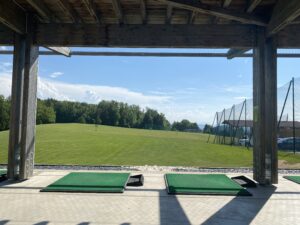
On the driving range at Golf du Belvédère, the same pattern is regularly observed among improving golfers: those who first work on striking the ball in the center gain more actual distance than those who focus solely on swing speed. This is often the first correction to make before tackling the more technical aspects of the swing.
The fundamentals for a successful driving test
Before even thinking about swing speed or distance, four technical elements must be checked at each session. These are the same points that the instructors at the Golf School work on with new students, regardless of their starting level.
1) Posture and stability
A stable stance facilitates a smooth and repeatable swing. Feet wider than shoulder-width apart, torso slightly inclined forward, arms relaxed: simplicity takes precedence over the pursuit of power. Body weight should be evenly distributed between both feet at address, with a slight weight on the back leg to promote the desired upward angle of attack on the driver.
2) Ball position and tee height
Position the ball inside the front heel (for a right-handed golfer) and use a tee that's high enough—about half a ball's length above the clubface. This is essential for hitting the ball on the upswing, a crucial condition for good distance. A tee that's too low is one of the most common causes of topped shots or low trajectories that lack distance, even with a good swing.
3) Grip and alignment
A neutral grip and consistent alignment significantly reduce dispersion. Most slices observed on the driving range stem from an overly open alignment, identifiable even before the swing begins. Placing a club on the ground parallel to the target line for a few practice balls allows you to visualize this alignment and correct a flaw often invisible to the player themselves.
4) Tempo, often neglected
Tempo—the ratio between the speed of the backswing and the downswing—directly influences the consistency of contact. A tempo that is too fast on the backswing rushes the transition and disrupts the body's natural sequence (hips, torso, arms, club). Consciously slowing the beginning of the swing, without changing the speed at impact, often improves accuracy faster than purely technical work on the swing plane.
Driver, wood or hybrid: which club to use off the tee?
The driver isn't always the best option. On a narrow or risky hole, a wood or a hybrid This often helps to secure the score rather than jeopardize it. The choice of tee club should depend on the actual width of the fairway and the player's usual dispersion, much more than on the desire to "bring out the big club".
| Club | Main advantage | When to play it |
|---|---|---|
| Driver | Maximum distance | Fairway wide, with confidence |
| Woodland | A straight trajectory, easier to control | Medium hole, wind present |
| Hybrid | Very reassuring | Narrow hole, danger nearby |
What distance should I aim for with the driver?
There is no single "normal" distance: it depends mainly on the level of play and the swing speed.
| Level | Average distance with the driver |
|---|---|
| Beginner | 150 to 180 m |
| Regular player (handicap 15-30) | 190 to 220 m |
| Confirmed (index below 10) | 220 to 250 m |
| Expert player | 250 m and more |
These guidelines are mainly used to set a realistic objective: 180 meters down the fairway is better than a 230-meter shot out of bounds that costs a penalty stroke.
How to gain distance without losing control
Distance comes primarily from the effectiveness of the contact, not the force applied to the swing: centering the ball on the clubface, a slightly upward angle of attack, a consistent tempo, and equipment suited to the player's swing speed. A poorly fitted driver (too low a loft for a modest swing speed, for example) can single-handedly cost a player 10 to 15 meters, regardless of the quality of their swing.
Three concrete levers allow you to gain distance without sacrificing precision:
- Centering An off-center contact of just one centimeter can reduce the distance by 10 to 20 meters depending on the swing speed. This is the first point to correct before any power work.
- The angle of attack : hitting the ball slightly upwards (and not downwards, as with an iron) reduces spin and increases the ball's roll after landing.
- The equipment A loft, shaft, and clubhead weight tailored to your personal swing speed often yield more distance than a technical change. A club fitting at the driving range allows you to verify these settings concretely rather than guessing.
It is also worth remembering that a greater distance is only progress if it remains playable: a player who gains 15 meters but loses half of his fairways does not really progress, he simply shifts the problem to the next shot.
Practicing driving: effective routines
Practicing "at random" is not enough: a structured routine accelerates progress and transfers better to the course than a simple series of aimless ball hits. On the Belvedere Golf practice, The method that works best with our students is based on three simple principles:
- Change targets with each shot rather than repeating the same shot.
- Vary the clubs (driver, woods, hybrid) to simulate real course conditions.
- Perform your complete routine before each shot, including on the practice range.
Visualizing a specific hole—hazard on the right, bunker on the left, safety zone in the center—during a practice session also prepares the player mentally: it's often the lack of routine, more than technical skill, that explains the difference between a good practice round and a disappointing one. A player who can drive well on the driving range but loses their composure on the course generally gains more by working on their mental routine than by trying to increase their swing speed.
To progress more quickly within a structured framework, the’Belvedere Golf School offers support with state-certified teachers, adapted to all levels of play.
Common mistakes to avoid
- Force the swing instead of seeking a smooth tempo at 70-80 % of maximum speed.
- Ball poorly placed in the stance, too far back or too far forward.
- Approximate alignment, often opened without the player realizing it.
- Inappropriate grip, too weak or too strong depending on the trend (slice or hook).
- Lack of routine, which makes each move different from the previous one.
Correcting these points in order—first address, then swing—yields faster results than working on clubhead speed first. A player who adjusts their alignment and ball position often sees a noticeable improvement in a single session, even before changing anything in their stroke.
The driving strategy in golf: choosing the right shot before swinging
A good drive is first and foremost a strategic choice. Contrary to popular belief, it is not always necessary to use the driver from the start: the real objective is to place the ball in a favorable area for the next shot, not to hit it as far as possible.
Before each departure, three simple questions help guide the choice of club:
- Where are the major hazards (water, out of bounds, bunkers)?
- What is my usual dispersion with the driver?
- Which club allows me to stay in the game with the most security?
Reading the hole before choosing a club often changes the score more than a technical improvement in the swing. A player who is willing to play a fairway wood on a narrow hole, rather than a risky driver, transforms a real danger into simple strategic prudence—and saves their driver for holes where they can truly benefit from it.
On a course like that of the The Belvédère Annecy Golf Course, where some tees offer an unobstructed view but tight holes, this thought before the swing often saves more strokes than a longer but inaccurate driving.
Conclusion: Key takeaways
Working on the basics—posture, ball position, alignment, tempo—and choosing the right club at the right time remains the fastest way to improve your driving. A good drive isn't a perfect swing: it's a useful, repeatable, and strategic shot, much more than simply seeking power as described on the page Wikipedia golf club.
Want to put these tips into practice on a real course? The The Belvédère Annecy Golf Course welcomes you to its practice area to work on your driving in real conditions, with views of the Aravis and Mont Blanc.
FAQ: How to master the golf drive without forcing it?
How to drive well in golf in 5 simple steps
Choose the safest club according to the situation (driver, wood or hybrid), place the ball on the front heel with a fairly high tee, swing at 70-80 % without forcing, and finish in balance, chest towards the target.
Why am I slicing with the driver?
The slice most often comes from an outside-in club path, a grip that is too weak, an open alignment at address, or a ball positioned too far back in the stance.
Should you hit the driver hard?
No. A relaxed and balanced swing at 70-80 % of maximum speed generally gives more useful distance and much more accuracy than a forced swing.
What alternative to the driver is there at the start?
Fairway woods and hybrids are often easier to control and more consistent than drivers, especially on narrow holes or into the wind.
Why am I lacking distance when driving?
A lack of distance most often comes from poor ball centering on the clubface, a downward rather than upward angle of attack, or equipment poorly suited to one's swing speed.