Driving distance in golf: what is the average distance per skill level?
Driving distance in golf varies greatly depending on the player's skill level: a beginner typically hits the ball between 140 and 180 meters, an experienced amateur around 185 to 210 meters, and a player with a handicap below 5 often exceeds 250 meters. These guidelines allow players to track their progress without chasing an absolute number.
Expert advice: Never compare your distance to that reported by other players on the course — "eyeballing" estimates almost always inflate the figures by 10 to 20. Only a measurement on the driving range, ball by ball, provides a reliable basis.
Summary
Driving distance in golf: the reference chart by skill level
Before trying to gain distance, it's best to know where you stand. Here are the driving distances in golf by skill level, including carry and run, on a dry fairway under normal conditions:
| Level | Distance driver (men) | Distance driver (women) |
|---|---|---|
| Beginner | 140 – 180 m | 110 – 140 m |
| Intermediate amateur (handicap 15-24) | 185 – 210 m | 140 – 160 m |
| Good amateur (index 6-14) | 210 – 230 m | 160 – 180 m |
| Very good player (handicap ≤ 5) | 240 – 255 m | 180 – 200 m |
| Professional player | 270 – 300 m and above | 220 – 250 m |
These figures are orders of magnitude, not targets to be reached at all costs: two players of the same index can have a difference of 20 to 30 meters depending on their morphology, their swing speed and their equipment.
Distance carry and total driving distance: don't confuse these two measurements
A driving distance figure in golf only makes sense if you know what distance you're talking about. carry corresponds to the distance in the air, from the tee to the point where the ball lands. total distance adds the roll after landing, which varies depending on the firmness of the ground and the launch angle.
On a soft fairway, the roll can be almost nonexistent. On a dry fairway in summer, it can add 15 to 25 meters to a well-launched drive. This is why two players with the same swing speed can post very different total distances from one season to the next, without their technique having changed.
This distinction also explains why spontaneously given figures on a course are rarely reliable: a player who estimates their distance "by feel" unconsciously adds the carry and the run, without separating what actually comes from their swing from what comes from the terrain. A simple change in the weather, a fairway soggy after rain or, conversely, dry after several days of sun, is enough to vary the total distance by 15 to 20 meters for an otherwise identical swing.
Distance to the driver in golf and distance to other clubs: where is the driver located?
The driver is almost always the longest club in the bag, but the difference in length compared to the other clubs provides useful benchmarks for assessing the consistency of your driving distance. For the average amateur, the typical progression looks like this:
- Wood 3 : generally 15 to 25 meters less than the driver.
- Hybrid : approximately 30 to 40 meters less than the driver.
- Iron 7 : often 60 to 80 meters less than the driver.
If the difference between your driver and your 3 wood is much greater than these marks, it often indicates a problem with centering or adjustment rather than a lack of speed: the driver, with its more closed face at impact and its longer shaft, is the club most sensitive to contact errors.
Why does driving distance in golf vary so much from one player to another?
Several factors explain the discrepancies observed in the table above, and they are not limited to physical strength:
- The swing speed, logically correlated with distance, but not linearly.
- The ball centering quality : an off-center contact can cause a loss of up to 40 % of distance, regardless of the speed generated.
- L'angle of attack and angle of launch, which determine the trajectory and therefore the final roll.
- The loan of equipment Loft, shaft, and head forgiveness directly influence performance.
- L'age and physical condition, which naturally cause the swing speed to change over the years.
The centering and angle of attack often play a more significant role than brute force in the difference in driving distance between two golfers. Two golfers with the exact same swing speed measured by radar can have a 30-meter difference in total distance if one consistently hits the ball in the sweet spot while the other regularly strikes it with their toe or heel. This reality explains why the pursuit of pure speed, without prior work on contact, often disappoints golfers who attempt it.
If you wish to take concrete action on these levers, our article Gaining distance on the golf drive without forcing it details the complete method, technique by technique.
Does driving distance decrease with age?
Yes, gradually. The age-related decline in swing speed generally results in a decrease in distance spread over several years rather than a sudden drop. A player with a good handicap can nevertheless limit this decline through consistent ball striking and equipment adjusted to their current swing speed.
How to know your true driving distance in golf
Many golfers overestimate their distance because they base it on their best shot of the session, not their actual average. To obtain a reliable figure:
- Hit at least 10 drives under the same conditions.
- Eliminate the best and worst moves (often statistical accidents).
- Average the remaining 8 shots, measured by GPS or laser rather than estimated.
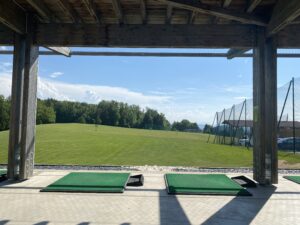
A driving range that's too short completely skews this measurement: if your best drives regularly go beyond the landing zone, it's impossible to know your true total distance. The multi-level indoor driving range of the The Belvédère Annecy Golf Course, 230 meters long, allows the vast majority of amateur players to see their balls land and roll in the reception area, without the distance markers being truncated at the end of the field.
Measuring tools also make a real difference. A practice GPS or laser rangefinder provides a reliable total distance, whereas an approximate visual reference point (a tree, a sign) can easily introduce 10 to 15 meters of error depending on the viewing angle. For more precise tracking, launch radar directly measures club speed, ball speed, and launch angle, making it possible to determine whether a lack of distance stems from the speed itself or from poor energy transfer at impact.
Driving distance in golf: should you always aim for the maximum?
Not necessarily. On the course, the maximum distance isn't always the most cost-effective option. A shorter drive, but well-positioned on the fairway, offers a clear approach angle to the green, while a longer drive that goes out of bounds immediately incurs a penalty stroke.
Common mistake: Always use your driver off the tee, even on narrow holes. A fairway wood or hybrid, which is easier to control, is often more cost-effective for scoring than a few extra yards of distance.
The real question, therefore, isn't "how to drive as far as possible," but "how to drive far enough to stay in contention." It's this distance, repeatable under pressure, that truly lowers scores.
The role of equipment: an unsuitable driver can cost meters
Equipment has a direct impact on driving distance in golf, even for a regular player. A loft that is too low for your swing speed reduces launch height and therefore roll; a shaft that is too stiff prevents you from properly loading the swing energy; an unforgiving clubhead heavily penalizes slightly off-center hits, which are common among most players.
This is why regular fitting makes sense, even for a player who does not radically change their technique from one year to the next: validation is done directly in real conditions, on the 9-hole course, on the same day.
Conclusion: Knowing your distance helps you progress better
Driving distance in golf depends less on power than on consistency of contact, launch angle, and having equipment truly suited to your swing. Comparing your current distance to benchmarks for your skill level allows you to set realistic goals, without comparing yourself to other players' approximate estimates. Measured under good conditions, with a sufficiently long driving range and reliable equipment, this distance becomes a useful indicator of progress, to be tracked season after season rather than based on a single, significant shot.
To delve deeper into the technical subject of golf, A personalized fitting remains the most reliable way to gain lasting yards rather than just temporary gains. The ProShop team at Golf du Belvédère offers a driver fitting validated the same day on the course — don't hesitate to book an appointment at the ProShop to take stock of your equipment.
FAQ: Distance to the drive-through: what is the average per level?
What is the driving distance for a beginner in golf?
A beginner typically hits their driver between 140 and 180 meters for a man, and between 110 and 140 meters for a woman. These figures improve rapidly with better ball striking, well before any gain in power.
What is the difference between carry distance and total distance?
The carry is the distance in the air to the point of impact, while the total distance includes the putt after landing. On a dry fairway, the putt can add 15 to 25 meters to the carry distance.
At what distance can we say that we are driving far?
Beyond 230 to 240 meters, an amateur is considered a long-driving player, which generally corresponds to a handicap of less than 10. Below 180 meters, the priority remains centering rather than seeking distance.
Does driving distance decrease with age?
Yes, but gradually, in line with the natural decrease in swing speed. Equipment adjusted to its current speed often helps to limit this loss of several meters.
How does the Belvedere practice area help to determine one's true distance?
Its length of 230 meters on a covered, multi-level driving range allows the majority of amateur players to see their drives land and roll in the reception area, without a truncated reference point at the end of the course, unlike a driving range that is too short.
Is the driver always the right choice to start with?
No. On a narrow or dangerous hole, a fairway wood or hybrid is often more cost-effective for staying in play than a risky driver, even if the latter offers more potential distance.