Why learn golf? The real reasons to start in Annecy
Learning golf offers tangible and rapid benefits: micro-improvements from the very first session, a measurable stress-relieving effect, a complete body workout without high-impact movements, and a social activity you can enjoy at your own pace, at any age. Contrary to popular belief, this sport quickly rewards beginners who follow a simple method. At Golf du Belvédère in Saint-Martin-Bellevue near Annecy, you can discover this sport in an exceptional setting overlooking the lake and the Aravis mountain range, guided by state-certified instructors.
Many aspiring golfers still hesitate to take the plunge, convinced that the sport requires a significant budget, a particular level of physical fitness, or years of practice before they can truly enjoy it. In reality, golf is accessible from the very first hour of practice, provided you receive proper guidance from the outset. That is precisely the aim of this guide: to give you the real reasons to get started, without jargon or exaggerated promises.
Expert advice: Don't focus on distance in your first sessions; concentrate on the quality of contact, distance will come naturally with the regularity of the movement.
Table of Contents - Why learn golf? The real reasons to start in Annecy
How long does it take to start playing golf?
Less time than you might think, provided you start with a structured method. From your very first introductory session, you'll learn the club grip, posture, and safety techniques, and you'll already be making your first clean contacts with the ball. After that, short sessions of 30 to 45 minutes are often enough to stabilize the swing.
The golden rule remains simple: structured progression, short sessions and immediate enjoyment are better than a long, poorly supervised session.
Is now the right time for you to start playing golf?
There's no universally ideal time to start: some begin with their families during school holidays, others after a career change that frees up some time, and still others because a colleague or relative convinced them during a company golf outing. What really matters is starting with structured guidance rather than trying out the game on your own without any technical support.
From the Belvédère driving range, our instructors observe the same pattern every season: the golfers who progress the fastest are those who follow a structured introduction before increasing their independent practice sessions. This observation confirms a simple principle: starting without guidance unnecessarily lengthens the learning curve, whereas an hour of instruction establishes benchmarks that save several weeks of solo practice.
Another frequently asked question: do you need to be athletic to start playing golf? No. Golf doesn't require explosive strength or exceptional flexibility. It requires consistency and a willingness to learn step by step, making it an activity open to teenagers as well as golfers discovering the sport after 60.
7 real reasons to start playing golf
1. You progress without being punished
Unlike many sports that penalize beginners from the very first attempts, golf rewards you quickly. You can progress on several levels simultaneously: ball contact, direction, consistency of the swing, and then strategy.
The small victories that motivate you from the very first session:
- Contact : to feel the ball leave the club cleanly
- Direction : send the ball towards a defined area, without aiming for perfection
- Regularity : repeating a good action and reducing randomness
- Strategy : learn to play intelligently rather than forcefully
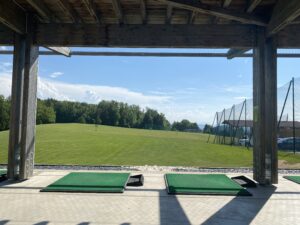
Visit covered driving range of 230 meters From the Belvedere, you can repeat these actions in all weather conditions, which significantly accelerates progress.
2. A disguised form of mental training
Golf is technical, but its true richness lies in the mental aspect. You learn to manage mistakes, to remain clear-headed after a bad shot, and to progress without self-sabotage. Each shot becomes a solitary moment: you pause, you choose your strategy, you execute.
This learning develops your concentration, your patience in the face of rarely linear progress, your resilience after a missed shot, and your management of pressure in game situations.
3. A complete sport that is gentle on the body
Golf develops coordination, balance, and a calm endurance through walking and repetitive movements, without the violent impacts of contact sports. The classic beginner's mistake is trying to hit the ball hard from the very first sessions, which is precisely what creates the most difficult technical flaws to correct.
By focusing on fluidity rather than power, you progress faster while preserving your body.
4. A social activity without pressure
You can come alone to clear your head or play with others without any pressure to perform. Between shots, conversation naturally resumes; during the shot, everyone focuses on their own technique. This alternation creates a calm sociability, very different from the competitive pressure of other team sports.
5. A lower barrier to entry than it seems
Golf isn't a complicated sport in itself; what often discourages beginners is starting without a clear structure. The method that avoids frustration remains the same: a structured introduction, short sessions, a simplified game, and then focusing on only one technical aspect at a time.
6. A practical stress reliever
Golf requires you to slow down, breathe, and focus on one action at a time. You don't need to arrive relaxed: the game itself calms you as you play, shot after shot.
7. A sustainable practice, adaptable throughout your life
Practice, introductory lessons, guided rounds, or a full 9 holes: you adjust the intensity, frequency, and format to suit your schedule. It's a sport you can enjoy for a lifetime, unlike more physically demanding disciplines.
This is also one of the reasons why so many golfers continue to learn golf later in life, sometimes after 50 or 60 years: the short format of a 45-minute practice session or a 9-hole course fits easily into a busy schedule, without requiring a full half-day.
The 3 mistakes that ruin a beginner's experience
Certain reflexes unnecessarily hinder the progress of new golfers:
- Wanting to make a strong impact from the start : prioritize rhythm and stability of movement
- Consuming video content instead of practicing The feeling you get on the practice range is worth more than hours of tutorials.
- Playing too seriously too fast Keep it simple, where fun takes precedence over the score.
Why learn to play golf at Belvédère, near Annecy?
Because learning golf is synonymous with meeting and sharing for us, you will not only find a beautiful training facility at Golf du Belvédère: you will also find a friendly atmosphere and a warm welcome that makes you want to extend the experience.
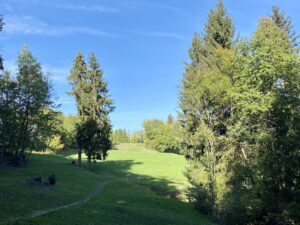
On our 9-hole golf course, You'll enjoy an unobstructed view of the Aravis mountain range. You'll also have access to excellent facilities to progress at your own pace:
- A 230-meter-long, multi-level indoor driving range
- A putting green and a chipping area dedicated to the short game
- A 9-hole course to put your training into practice
- A Golf School led by our state-certified instructors, Patrice, Alicia and Adrien
- Workshops are organized for children and teenagers on Wednesdays, Saturdays and during school holidays.
Every Sunday morning, a free initiation is organized to discover golf without commitment: all you have to do is register. You generally leave with two or three solid reference points to rely on for the future: a correct posture, a grip that doesn't turn into a bad habit, and a clear idea of what a clean contact is.
4-week express action plan
Here is the method our instructors use to guide a new golfer without discouraging them:
| Week | Objective |
|---|---|
| Week 1 | Guided introduction: club grip, posture, safety, first contact |
| Week 2 | Two short sessions focused on the quality of contact |
| Week 3 | Simplified game in compact or guided format |
| Week 4 | A technical reference point and a mental reference point, nothing more. |
To further your preparation, also consult our comparison of golf equipment for beginners, which details the equipment actually needed for your first sessions.
Learning golf alone, as a couple or as a family: which option should you choose?
The introductory course depends primarily on your initial motivation. If you want to try it out quickly without obligation, the free Sunday morning introductory session remains the simplest way to learn golf without pressure. If you prefer to learn at your own pace with personalized guidance, a Individual lessons Working with one of our teachers accelerates the correction of posture or grip defects from the very first sessions.
For a family outing, our A guide to starting golf with your children details the educational path most often recommended by our team: an introduction to test, a holiday course if the child takes to it, then the golf school for regular progress over the season.
Conclusion: Move from "I'm thinking about it" to "I'm starting".«
The reasons to learn golf The goal for 2026 can be summed up in a few words: an outdoor activity that is measurable, social, and sustainable, and that helps you grow mentally without exhausting you physically. The method remains simple: a structured session, short sessions, a simplified game, and above all, a focus on enjoyment.
The Belvédère Golf Club welcomes you every Sunday morning for a free introductory session led by our state-certified instructors. It's the perfect opportunity to see, in just one hour, if this sport is right for you.
FAQ: Why learn golf? The real reasons to start in Annecy
What are the main reasons for taking up golf?
The main reasons are: to progress quickly through micro-victories (contact, direction, regularity), to reduce stress through concentration, to develop mental strength, to practice a complete sport that is gentle on the body, and to enjoy an outdoor social activity that is adaptable to all levels.
How much does golf cost for beginners?
The budget depends mainly on the courses or introductory sessions taken, access to practice areas, and the equipment chosen. The most economical strategy is to try it out first with a free introductory session, then invest in equipment only once you've confirmed you enjoy playing.
At what age can one start playing golf?
You can start at almost any age. Golf adapts in frequency, intensity and format of play, making it an activity you can practice throughout your life by adjusting it to your physical condition and schedule.
Is golf difficult for beginners?
It might seem difficult if you start without a method. With a simple progression—structured basics, short practice sessions, simplified gameplay—you'll quickly enjoy yourself and avoid frustration. The goal isn't to be good immediately, but to be consistent.
What equipment do you need to get started with golf?
To get started, you don't need a full set of clubs. A few clubs, some balls, and comfortable clothing are all you need. Equipment is provided on-site during the free introductory session at the Belvédère.