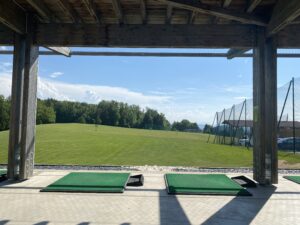
Why does my golf ball go to the right?
The simple diagnosis (start + curvature)
You are wondering Why does my golf ball go right? But in your mind, you thought you had a clean swing? Good news: this symptom is extremely common, and it's often resolved with 2 levers only - the club face and the club path — provided that a clear diagnosis is made (and that “correcting by feel” is stopped).
In this guide, you will:
- identify if you are more push, slice or push-slice,
- understand the most likely causes (grip, open face, outside-inside, alignment),
- apply a protocol in 10 bullets at the practice range to realign your trajectories.
To explore further with related content:
Summary
10-second diagnosis: first look at the starting point, then the curvature.
Before you touch your swing, answer two questions (and write down the answer, really):
- Where does your ball start? (left / center / right of the target)
- How does your ball curve? (moves back to the left / stays straight / moves even further to the right)
Most golfers make the opposite mistake: they first look at the club's curvature ("it slices!") and then try to fix it themselves. However, for a reliable diagnosis, the departure This gives you the first key piece of information: is the face arriving oriented correctly? Next, the curvature tells you if the face/path pairing is consistent.
Mini-matrix (simple): start × end of trajectory
- Start on the right + stay on the right : often push (open face vs target) and/or misleading alignment
- Starts on the right + right-hand curve very often push-slice (open face + exterior-interior path)
- Starts in the center + right curve : often slice (exterior-interior + slightly open front)
- Starts on the left + curve to the right : often pull-slice (more pronounced exterior-interior)
Trap #1: Your alignment is lying to you (and wrongly blames your swing)
“My ball goes right” is sometimes a misdiagnosis because your body isn't aligned as you think. Without a reference point on the ground, your brain “aims” with your upper body, compensates with your hands, and you end up with an open clubface… then you blame your swing. Classic.
Immediate test (1 minute): alignment rods
- Place a baguette (or a club) down towards the target : that's your line of play.
- Place a second baguette parallel for your feet/hips/shoulders.
- Hit 3 balls while forbidding yourself to “aim with your shoulders”.
If your drives are more centered, you've just saved a huge amount of time: your priority wasn't "changing the swing", but correct the address.
“Right” ≠ “slice”: words that avoid incorrect spellings
Putting the right word on the right problem prevents you from making the situation worse.
- Push : starts on the right and stays fairly straight (little curvature).
- Slice the ball curve distinctly to the right.
- Push-slice : starts on the right and curves even further to the right (the most frequent combination).
- Pull-slice : starts on the left and comes back sharply to the right.
Why is this crucial? Because a push rarely corrects itself like a slice. If you "force the inside-outside" on a push when your alignment is already to the right, you can get caught in a spiral of compensations.
The two causes that explain the majority of shots going right
1) A clubface that is too open at impact
A right-facing clubface at impact pushes the ball to the right. Then, depending on your swing path, it will either stay straight (push) or slide further (push-slice). The most common causes of an open clubface are:
- Grip too “weak” (right-handed): left hand too turned towards the target.
- Face already open at the address (very common).
- Tension hands/forearms: you “hold back” the closure (often out of fear of the hook).
- Irregular contact (heel/toe): the face “reacts” and the direction becomes unstable.
2) An outdoor-indoor club path
When the club comes in from the outside and slices the ball, you increase the likelihood of a rightward curve (especially if the clubface is open). Common causes:
- Downswing “upper body first”: shoulders pull, arms follow.
- Ball too far forward / stance too narrow: you "catch" by cutting.
- Intention to send a strong force: acceleration that disrupts the path.
The most cost-effective adjustment: your grip (visual reference in 5 seconds)
If you want a quick win, start here. For a right-handed player, go to:
- Look at the left hand: aim 2 to 3 visible phalanges (according to morphology); ;
- The thumb/index “V” points more towards the right shoulder.
If you can barely see a phalanx, your grip is often too neutral/weak: the face has more difficulty returning to square, and your ball “escapes” to the right.
Mini-test (3 balls)
Reinforce the grip slightly (without tightening it more), check a square face at address, then hit 3 balls at 70%: if the tee returns to center, you have a major lever.
Address: The 5-point checklist that prevents you from going off to the right
Before you try to "rework your swing," lock in your address. Otherwise, you're correcting a problem that was created... before you've even moved.
- Facing the square to the target (not “a little open”).
- Alignment : feet/hips/shoulders parallel to the line of play.
- Ball : not too far forward (especially with the iron).
- Balance : not on the heels, stable pressure.
- Relaxation : relaxed hands (tension = face that remains open).
Impact: 3 signs that scream “open face”
- You have the feeling of “blocking” the crossing (you accompany, you hold back).
- Your departures are systematically on the right, regardless of the club.
- You try to “control” the club until impact (and you lose the release).
In this case, your order of priority very often remains: grip → facing the address → release, and only then the path settings.
3 simple visual exercises to stop cutting the ball
Exercise 1: the “door” (path)
Place two tees in front of you like a small gate, aligned with the target. Your goal: to get the clubhead through in the door. If you touch the outside tee, you are coming from the outside: this is the outside-in pattern.
Exercise 2: Centered contact (the detail that changes everything)
Use impact spray or tape and look for contact in the center. A very strong heel/toe strike makes your steering unstable, and you then "blame" face/path when the contact was the real problem.
Exercise 3: 70% swing (face returning to square)
Take 5 swings at a controlled speed: your only goal is to feel the club return square, without tension. Trying to correct a shot going right by hitting harder is one of the quickest ways to amplify the problem.
“5 minutes / 10 balls” protocol (measurable result on the practice range)
When you want a quick fix without getting bogged down in the technical details, follow this plan:
- Balls 1 to 3 : grip + face (70% speed). Goal: refocus the departure.
- Balls 4 to 6 Alignment with sticks + ball not too far forward. Goal: remove the illusion.
- Balls 7 to 10 : “Gate” exercise (2 tees). Goal: reduce the curvature.
Simple objective: 7/10 balls which start in the center (or slightly to the left while the face is being "re-educated"). If you maintain this objective, you are on track for a lasting correction.
Two typical cases (and what to correct first)
Case 1: the ball starts to the right and stays on the right (push)
Here, the most frequent culprits are: open face at the address, grip too weak, Or right alignment. Your order of correction:
- Square face + slightly stronger grip
- Alignment rods (required for a proper diagnosis)
- Swing to 70% to stabilize the return of the face
Case 2: the ball starts to the right and continues to the right (push-slice)
You have often open face (departure) + exterior-interior (curvature). Your correction order:
- Grip + facing the address (recenter the tee shot)
- “Door” exercise (neutralizing the path)
- Centered contact (stabilize direction)
If your shots start going left… that’s often good news
When you stop leaving your face open, it's common to feel like "it's drifting left." Often, this isn't a new problem: it's the old rightward drift disappearing, revealing your true alignment. Adjust gradually (target, face, stance), but avoid reverting to the old reflex of "at least I know it's drifting right.".
Conclusion: your action plan (simple, reproducible)
To correct a ball If you're going to the right, you don't need 12 technical thoughts. Do this:
- Diagnose : start + curvature.
- Set the address : baguettes + square face.
- Adjust the grip : 2–3 visible phalanges.
- Neutralize the path : “door” exercise.
- Confirm : protocol 10 shots, objective 7/10 centered.
Useful internal resources:

FAQ
Why does my golf ball go to the right?
In golf, the ball veers to the right when the clubface is open at impact. This means the club is angled to the right at the moment of contact, directly influencing the ball's initial direction. This problem is often related to a weak grip or poor alignment.
What is the main cause of a ball going to the right?
The primary cause is an open clubface at impact, sometimes combined with an outside-in swing.
In summary:
• open face → ball to the right
• Exterior-to-interior path → accentuates the deviation
This is the most common case among beginner players.
What is the difference between a rightward shot and a slice?
A ball to the right does not always mean a slice:
• Ball that starts to the right and stays straight → open face
• Ball that starts left then comes back right → slice
The slice is therefore a combination of direction + sidespin.
How to quickly correct a ball that's going to the right?
To correct this quickly:
- slightly strengthen your grip
- check the alignment (feet, shoulders, hips)
- work on an inside-outside swing
- slightly close the clubface at impact
These adjustments often allow for immediate improvement.
Why is my ball going to the right with the driver?
With the driver, the ball often goes to the right because:
• The front of the club is open
• The swing is too outside-in
• The player is seeking too much power
The driver amplifies technical errors, especially in terms of grip and club path.
How do you hit a straight golf ball?
To hit a straight ball:
• Align your body correctly towards the target
• Ensure the club face is square at impact
• Adopt a neutral swing (neither outside-in, nor inside-out)
Consistency comes from a good balance between clubface and swing path.