Lower your golf handicap in 30 days: the week-by-week action plan
Lowering your golf handicap quickly requires a structured action plan rather than a new swing: improving your short game, adopting a more cautious course strategy, and recording more rounds so your handicap reflects your true ability. Spread over 3 to 4 weeks, this plan targets the costly mistakes, not the pursuit of the perfect shot.
Many amateur golfers practice regularly without seeing their handicap improve, simply because their practice time isn't aligned with what actually lowers a score. This guide provides a concrete, week-by-week plan to correct this.
Key points to remember: The fastest gain does not come from a new swing, but from eliminating the "disaster" holes — 3 or 4 per round — that weigh down the majority of amateur scores.
Table of Contents - Lower your golf handicap in 30 days: the week-by-week action plan
Can one really reduce their disability quickly?
Yes, to some extent. An amateur golfer can see measurable improvement within a few weeks if they focus their energy on high-impact areas—short game, error management, consistency—rather than spreading their time across the entire game. The speed of this improvement depends primarily on your starting level and your ability to consistently apply the plan, not on any particular talent.
The principle that changes everything: stop looking for the perfect shot
Most amateurs lose their handicap on three or four disastrous holes per round, not over the entire course. A mediocre shot followed by a prudent decision protects your scorecard far better than a spectacular shot attempted at the wrong time.
This change in logic — playing the safest move rather than the most ambitious one — is alone responsible for a large part of the quick wins seen among players who apply this plan.
Your action plan to lower your golf handicap in 4 weeks
Week 1: The express diagnosis
Before making any changes, identify where your extra strokes are going. On your next two or three rounds, note the number of putts, the greens in regulation, and the holes where you made a double bogey or worse. This simple analysis, requiring no special app or equipment, is enough to reveal your true priorities.
Also note, hole by hole, the precise moment your score went off track: a shot into the water, a three-putt, a missed bunker shot. This list, even if approximate, prevents you from guessing and allows you to start week 2 with a specific goal rather than a general impression.
Week 2: Securing the small game
This is the area where the gains are quickest to materialize. Rather than trying to nail every approach shot to the pin, aim for a wide area that gives you an easy putt. For a detailed plan on approach shots, chipping, and putting, see our dedicated article on the fastest method to improve at the small game.
Specifically, dedicate this week to just three areas: the chip approach, a basic bunker shot, and putting from under two meters. There's no need to spread your practice sessions around spectacular shots that you'll rarely use in a round.
Week 3: Play a more cautious route strategy
On the course, the goal this week is simple: aim wider, accept bogey, eliminate avoidable penalties. These decisions, more than technique, explain a good portion of the amateur golfer's missed holes. Our article on the golf course strategy details this approach hole by hole.
On each hole, ask yourself only one question before playing: what is the consequence if this shot is missed? If the answer involves a penalty or a serious obstacle, always choose the safest option, even if it seems less ambitious.
Week 4: Consolidate and save your maps
This final week is about stabilizing what has been set up, while also ensuring your cards are officially submitted. A handicap can only be lowered if your good performances are recorded—a point often overlooked by players who play a lot of unranked casual games.
Consider this 4-week cycle as a basis to repeat: once the first month has passed, take a new diagnosis to identify the next leak of blows, which was not necessarily visible at the start.
Concrete example: a player who applies this plan
Consider the case of an amateur golfer with a 24 handicap who consistently lost 3 to 4 strokes due to missed bunker shots and three-putts. His week 1 diagnosis revealed that the majority of his "disastrous" holes stemmed from a single cause: overly ambitious approaches to the pin from over 100 meters.
In week 3, he simply changed his target: aiming for the center of the green rather than the flag whenever the distance exceeded 100 meters. Without altering his swing, this single adjustment significantly reduced his double bogeys in subsequent rounds, confirming that strategy often carries more weight than pure technique.
The 3 mistakes that slow down your handicap reduction
Even with a clear plan, certain reflexes can hinder progress without the player realizing it. Here are the three most common, observed in the majority of amateurs who plateau despite significant training time:
- Trying to fix everything at once, instead of following a clear order of priority;
- Spend most of your practice time on the driver, the least used club on a course;
- Not recording good cards prevents the index from reflecting actual progress.
Should you play more or train more to quickly lower your handicap?
The two are complementary, but in different proportions depending on your availability. Playing regularly allows you to apply your decisions in real-world conditions and improve your handicap through recorded scores. Targeted practice, focusing on the areas identified in week 1, accelerates the correction of shot leaks.
A player who focuses on only one of the two will always progress more slowly than one who combines both, even modestly. If your time is limited, opt for two short, targeted sessions rather than one long, general session without a specific goal.
A simple tip: if you only have one hour a week, dedicate it to the short game rather than the long game. This is where you'll find the most favorable ratio of strokes gained to time invested for a busy amateur.
The 9-hole format, an accelerator for implementing this plan
A 9-hole course, like the one at Golf du Belvédère in Saint-Martin-Bellevue, makes this type of plan particularly easy to implement. Its shorter playing time allows for more frequent practice during a busy week, which is precisely what most golfers lack to translate a theoretical plan into measurable results on their scorecard.
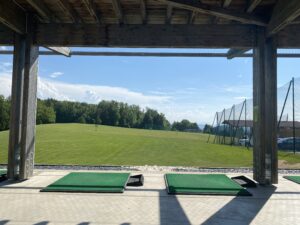
The club's multi-level driving range, with its 230 meters of hitting length, also allows you to combine short game and long game work in a single session, without multiplying the trips.
Adapt the plan according to your starting level
This 4-week plan works for most amateurs, but the emphasis will vary depending on your current skill level. A beginner with a high handicap will gain more by working on ball contact and short game consistency, even before considering sophisticated strategy. An intermediate player, on the other hand, will primarily benefit from managing risky holes and developing mental discipline, as their technique is already solid enough to score well if they make better decisions.
In both cases, the plan's structure remains the same: diagnosis, small-sided game, strategy, consolidation. Only the time spent on each step needs to be adjusted to your playing style. A teacher from the Belvedere Academy can help you quickly identify which of these two profiles best suits your current game, so you don't waste time on a secondary strategy.
What you can realistically expect in 30 days
| Profile | Realistic progress in 30 days |
|---|---|
| Beginner / high disability | Significant improvement in consistency, variable gains on the index |
| Intermediate player consistently applying the plan | A few points gained, to be confirmed on several maps |
| Inconsistent player, partial implementation of the plan | Slower progression, often visible after 2 to 3 months |
These guidelines are indicative only: progress depends on your consistency in playing and the rigor with which you apply each step, not just on the time elapsed.
Conclusion: a simple plan, applied consistently
Lower your disability Improving your golf game quickly isn't about talent, but about well-ordered priorities and consistent application. By following this 3- to 4-week plan—diagnosis, short game, strategy, then consolidation—you maximize your chances of seeing real progress on your scorecard.
The most important thing is to maintain this course over time: a month of rigorous application always weighs more heavily than an entire season of scattered training without a clear priority.
For a complete and sustainable method beyond these 30 days, consult our guide to improving your golf handicap, which delves into each of these levers.
Ready to start your week 1?
FAQ: Lowering your handicap in golf
Is it possible to lower your handicap by 5 points in one month?
This is still rare and depends heavily on the starting level. A beginner often progresses faster in absolute terms than a regular player, for whom each point won requires more consistency.
Is an intensive training program necessary to quickly reduce one's disability?
No, it's not essential, but an internship can speed up the initial diagnosis by identifying your priorities in a single session rather than over several weeks of trials.
Does the 9-hole format allow you to progress as quickly as an 18-hole format?
Yes, often faster in practice, because it allows you to play more frequently over the same period, which matters more for the application of a plan than the length of a single game.
Do you have to record all your games for the handicap to decrease?
Only cards played under the conditions required by the handicap system are recorded. A good unrecorded hand has no effect on your handicap index, hence the importance of this practice.
Does mental strength count as much as technique over 30 days?
Yes. Managing bad holes directly influences the final score, often more than the technical quality of an isolated shot.
What if my disability does not improve despite this plan?
Review the assessment from week 1: it's likely that your training isn't yet targeting the area that's causing you the most pain. A consultation with an instructor can then help you quickly identify the correct lever.