Golf slope: definition, calculation and strategies to improve in 2026
The slope The handicap index of a golf course is an integer between 55 and 155 that measures its relative difficulty for an amateur player ("bogey") compared to a "scratch" player (handicap 0). The reference value is 113 : above, the route is more difficult than average; below, easier.
Expert advice: Always check the exact slope of your tee color on the FFG app or at the golf reception before a competition, rather than relying on a regional average.
Table of Contents - Slope in Golf: Definition, Calculation, and Strategies for Improvement in 2026
What is slope in golf?
The slope evaluates the difficulty gap between two player profiles on the same course: the scratch golfer (handicap 0) and the bogey golfer (handicap 18-22). Unlike the Course Rating, While the slope rating measures the absolute difficulty for a scratch player, it is specifically interested in what the vast majority of amateurs experience.
In summary:
- Slope = 113 → medium difficulty
- Slope > 113 → course more difficult for a bogey player than for a scratch player
- Slope < 113 → less marked difference in difficulty between the two profiles
Standardized by the World Handicap System (WHS), The slope guarantees fair play worldwide and is directly used in calculating the playing handicap.
Why slope rating really matters to an everyday golfer
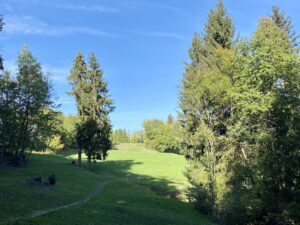
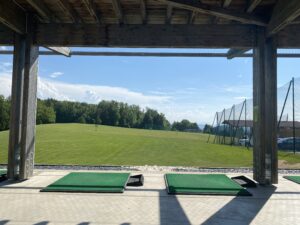
On the driving range as on the course, the perceived difficulty is never simply a matter of par. Two par-72 courses can play very differently depending on the width of the fairways or the size of the greens—this is precisely what the slope rating aims to quantify. On a 9-hole course like the Belvédère in Saint-Martin-Bellevue near Annecy, the undulating terrain and the fairways, sometimes narrowing through the woods, are typical of the kind of factors that increase the slope rating, regardless of the course's length.
This is also why state-certified teachers of the’Golf school From the very first lessons, they insist on choosing the right start rather than on seeking distance: playing a course according to its slope rating means playing according to your actual level.
How is the slope of a course calculated?
The slope rating results from a technical evaluation carried out by approved federations, which compare the expected performance of two profiles: the scratch player and the bogey player.
The official formula
Slope (men) = (Bogey Rating − Course Rating) × 5.381
Slope (women) = (Bogey Rating − Course Rating) × 4.240
The Bogey Rating is the expected score of a bogey player; the Course Rating (similar to SSS in France) that of a scratch player. The greater the difference between the two, the higher the slope.
The criteria taken into account
- Total length of the route — the longer it is, the more power and precision it requires.
- Topography and relief — Ascents, descents and slopes alter the power and trajectory required.
- Fairway width — a narrow fairway penalizes the inconsistent player more than the scratch player.
- Obstacles (bunkers, water, rough, trees) — their strategic location especially complicates the game for high handicap players.
- Green configuration and speed — Fast or very sloping greens require fine control, which is more difficult for a bogey player to achieve.
- Game conditions — Wind, humidity and ground conditions influence ball roll and distance.
Each starting department (red, yellow, blue, white) and each gender has its own slope, as the perceived difficulty changes with the length played.
Slope and handicap: the formula you need to know
The slope is directly used in the calculation of the game handicap, that is to say, the number of strokes a player receives on a given course:
Playing handicap = (Index × Slope / 113) + (SSS − Par)
Concrete example: A player with an 18 handicap approaches a course with a slope rating of 140, with an SSS of 72 for a par of 71.
Playing handicap = (18 × 140 / 113) + (72 − 71) = 23,3, rounded to 23 shots returned.
The same player, on a course with a slope rating of 113 and a SSS equal to par, would only receive their gross handicap. This is the whole principle of the system: the more demanding the course, the more strokes are given, to ensure fair competition.
Low, medium, high slope: how to adapt your strategy
| Difficulty level | Slope | Recommended game strategy |
|---|---|---|
| Easy | 55 – 110 | A more offensive style of play, aiming for birdies, working on consistency. |
| AVERAGE | 111 – 125 | Balancing risk-taking and caution depending on the holes |
| Difficult | 126 – 140 | Favor the center of the greens, avoid penalty areas |
| Very difficult | 141 – 155 | Control game, hole-by-hole strategy, accepting the possibility of losing a few shots |
A player who progresses on high slope courses without seeing their score explode is generally a sign of real technical and mental evolution — a good indicator of progress to follow over time, beyond just the handicap.
The "slope" mode on rangefinders: useful, but regulated
Many laser rangefinders embark on slope mode, This feature automatically adjusts the measured distance based on the terrain's elevation changes (a distance uphill appears longer, a distance downhill shorter). It's a valuable training aid for choosing the right club.
Key points to remember: this mode is banned in official competition, This is because it would give an unfair tactical advantage over a player who has to judge the terrain by eye. It is therefore essential to know how to disable this function before starting a tournament—an oversight that can lead to disqualification.
Where to find the slope rating of your course
In France, it's the French Golf Federation (FFG) which assigns and updates the slope rating for each course, generally every ten years, for each tee color. The exact value is available on ffgolf.org or in the Kady app, as well as on the scorecard given at reception.
On a 9-hole course like Belvédère, the slope and SSS (Slope Score) are calculated for the 9-hole course and then adjusted for competitions played over 18 holes (two loops). Since these values are specific to each club and each tee color, it's always best to check the exact figure displayed at the golf course reception or on the FFG app rather than relying on a regional average: two neighboring courses in Haute-Savoie can display very different slopes depending on their terrain and layout.
Why slope is essential in competition
By making scores obtained on completely different courses comparable, the slope standardizes fairness between clubs, regions and countries. This is the mechanism that allows a player to carry their index from one course to another, or even from one country to another, without losing consistency — a pillar of the World Handicap System adopted almost universally since 2020.
In practice, during a ranking competition, it is never your gross index that determines your net score, but your game handicap recalculated for the course and tee played that day. Two players with the same handicap can therefore receive a different number of strokes depending on whether they play a course with a slope rating of 118 or 145. This is precisely what allows a beginner and an experienced player to compete in the same competition without the outcome being predetermined.
Slope and Course Rating: do not confuse the two indices
Many golfers confuse slope rating and Course Rating (called SSS in France), even though these two indices answer different questions. Course Rating indicates the score a scratch player should achieve on the course under good conditions — it is expressed in strokes, often close to par. slope, It does not express a score but a relative difference: it measures how much the difficulty increases for a bogey player compared to the same scratch player.
In other words, a course can have a moderate Course Rating (easy for the best players) while still displaying a high slope rating if it heavily penalizes less precise players—for example, with narrow fairways or hazards close to the usual landing areas for amateurs. This is why both ratings are always shown together on the scorecard, and neither should be read in isolation to judge the true difficulty of a course.
A bit of history: why was the slope invented?
The slope rating system was developed in the United States in the late 1970s by Dean Knuth, then a member of the USGA's Handicap Research Team. Before its introduction, only the Course Rating was used as the basis for calculating handicaps, which mechanically favored courses that were easy for scratch golfers but tricky for amateurs. The observation was simple: two courses with the same Course Rating could produce very different scoring differences for bogey players, depending on the presence of penalizing hazards near the usual playing areas.
First tested in Colorado in 1982, the system was rolled out across the United States in 1987, and then gradually adopted by most international federations. Since 2020, it has been one of the cornerstones of the World Handicap System, which unifies the former national systems (including the European EGA) under a common framework.
Conclusion: Slope, a common language for all golfers
The slope rating isn't just a technical number on a scorecard; it's the tool that allows a beginner and an experienced player to compete on equal footing, regardless of the course. Understanding it is already a step towards improving your understanding of the game—knowing how to choose your tee shot, adjust your scoring goals, and adapt your strategy hole by hole.
To delve deeper into the subject of official sources, see the page Slope rating on Wikipedia traces the complete history of the system, from its creation by the USGA in the 1980s.
Want to put these concepts into practice on a hilly, human-scale course?
Come and discover the 9 holes of the Belvedere, between Lake Annecy and the Aravis mountain range, or contact our team for any questions about your disability and your progress.
FAQ: Slope in golf: definition, calculation and strategies to improve in 2026
How exactly is the slope calculated?
It is calculated from two values, the Course Rating (expected score of a scratch player) and the Bogey Rating (expected score of a bogey player), according to the formula: Slope = (Bogey Rating − Course Rating) × 5.381 for men, × 4.240 for women.
What is the difference between slope and SSS?
The SSS (Scratch Score Standard) measures the difficulty of a course for a scratch player and is close to par. The slope rating, on the other hand, measures the difference in difficulty between a scratch player and a bogey player.
How to use the slope to choose your starting point
If the slope of the back start is very high compared to your level, opt for a more advanced start: the ratio between your level and the perceived difficulty will be more balanced.
Is the slope mode of a rangefinder allowed in competition?
No. It is allowed in training but prohibited in official sanctioned competitions, as it provides a tactical advantage not accessible to all players.
Does the slope change over time?
Yes, it is reassessed by the FFG approximately every ten years, or after work that significantly alters the course (new bunkers, replanting, modification of the greens).